
As I write more, I notice that AI is a growing theme in my works. As with any character, I tend to write them in both good and bad light. I feel like as I go further in my career and as AI continues to develop, my AI’s characters will become more nuanced to reflect them and human nature. I feel, for the sake of preventing discourse, I state my stance now.
As a whole, and as of writing this in May of 2025, I have a neutral stance on AI. Because to me, right now, AI is a tool and like any tool, its use is a reflection of the wielder. From what I have seen and read with AI, when it is given data on a specific task, it is an incredible tool. AI has helped in discovering Antibiotics and detecting cancers, which will save so many lives. In my field of history, it’s been amazing as it’s discovered over 100 Nazca Lines that we have somehow missed and helped us translate and decode languages in minutes that took us centuries to do prior. This isn’t even mentioning my favorite benefit of AI in that we are using it to decode the languages of whales and elephants with the hope of keeping them away from human settlements so they don’t get hurt. Which, if successful, has the potential to do miracles in environmentalism, as people can more easily empathize with animals. Which would decrease dehumanization and hopefully deter animal cruelty.
There’s also a chance the orangutans are right and some idiot will get the idea to put them to work. Which, hopefully, is just in the realm of satire. Which brings me to my next point. We have been too quick to adopt AI in the modern world. When thinking of AI or transhumanism, I oftentimes think of the Unabomber’s Manifesto, and one of his main points is that humans are quick to adopt technology as they view it as being able to save them from human nature and flaws. When in actuality, we need to reflect on our flaws and shortcomings in order to be worthy of wielding technology. Clearly this is not the approach we have taken as businessmen, politicians, and the wealthy would rather take the accelerationist route and just implement it into everything consequences be damned. It’s cringeworthy seeing companies adapt it without even knowing what it is in order for their stocks to rise. A trend that isn’t surprising given how hasty some people were to adopt crypto and NFTs. Not everything needs AI, not everything needs to be smart. Sometimes simplicity is best. AI takes a lot of energy to make, and if overused, can hurt the environment in disastrous ways, which accelerationists don’t care about.
It also has the added consequence of making the AI inbred and causing it to replicate on itself, making it less useful. It does have another function, though, which I don’t see often brought up. Like any piece of technology, AI helps us understand the world better. In this case, it more specifically helps us understand our own nature better and the faults of the current systems, like the job market, education system, and social media. As these systems rely on appearance and rewards rather than quality. Why spend days on a resume and sending job applications for a CEO who is more replaceable than you are, when AI can do it for you? Why study and risk failing when you can have AI write your paper for you? Especially when the risk is not getting into a college of your choice and having a scholarship so you can afford it. Why waste hours chatting with people who probably aren’t real when you can make more bots to follow your account and help you get fame and notoriety?
We say “work smart and not hard,” and in our current system, the logical conclusion of this phrase is to use AI. The system needs to be reformed and adapted to reward quality, not quantity. I think the most egregious example of this is with art. As a collective society, we do not value art. Those who value it are called geeks, and in the current er,a we are seen as a social cliche, nothing more, nothing less. The reasons for how and the results are a discussion for another day. My point is, we do not value art, and AI art makes sure we know it.
AI Art is a fascinating subject; you are either for it or against it. I personally think this is a false dichotomy, and viewing it one way or the other ignores key facts about us as a species and our history. If you are for AI Art you most likely support it because you are of the belief that it makes art more accessible. In that case, yeah, you’re right. The thing with art, as I have learned as I started to practice, is that in many ways it’s a privilege. Art takes time, and not everyone has the time to draw, and even less time to learn how to do it. It also requires resources. You can get a pencil and a sketch pad for like 20 bucks, but if you really want to commit and improve your quality, you either have to get more expensive material or go digital, which, if you are tight on cash, can be hard to maintain. AI is quick and free to use, so if you want to make a character reference for a D&D game or a profile picture, AI can easily help you with that. Though personally I thinking finding an image is a way better option and is what I do.
Now I can already hear you saying. “If you want something like that, hire someone for commission.” Which again gets into the same issue of not everyone having money. Commissions are expensive and can be a risk if they’re not from a reputable source. Don’t get me wrong artists who take commission have good reasons for there prices, like the fact they don’t get them often (in part due to AI) and they take time to make, which is a nonrenewable resource and one they would have less of if they have to have other sources of income.
If you’re using AI Art for something meant to be amongst friends or a meme or anything else were it’s insane to waste $30-50 when you don’t have that kind of money, then yeah, go for it. I don’t think you will enjoy it as much as a drawing made by a person. I think it’s more rewarding to try to learn how to draw because it would give you more creative freedom and is far more rewarding. If you don’t have the passion for it however, then I don’t think you should be shamed over it. The exception is if you’re using it to make a profit which is scummy behavior.
This leads me to my thoughts on Anti-AI Art. I won’t lie while I align myself more on this side on a macro level. I don’t really agree with a lot of the arguments. First off, AI-Art isn’t going to replace human art. That’s not possible; humans will always have a desire to create. People made the exact same argument with photography when it first came out, and guess what, people are still drawing now and photography is classified as its own form of art. I don’t know if AI-Art will get to that point because, unlike photography or art, you cannot imbue your personal experience in it with the colors, the shading, lines, etc. AI Art instead depends on the images of others to make its art. Many would call this stealing, which I think is a little hypocritical because most artists use references themselves. I think the reason why AI Art doesn’t get the same grace is because, unlike people who also add their thoughts and experience in their creations, AI Art hasn’t gotten to that point yet which makes it more shallow.
Ironically, this shallowness, the surface level of it, will be appealing to companies who will to use it instead of paying commissions. Which I don’t see going well in the long run, because as we have been seeing in the entertainment industry, constantly rehashing stuff makes it less enjoyable. As Hollywood and the gaming industry rely more on past ideas and use AI to make whole films and games instead of helping improve small things like lip syncs for translations, people are going to get sick of it and go to independent artists.
I am a firm believer that the future is indie, we can already see that in the animation and gaming scene. While there will always be plebeians and philistines who will be blinded by nostalgia and unable to see the AI gloss as younger generations grow up, we are likely to see more of them appreciate art. The old kings are dying, and independent artists are succeeding them. We should be more focused on ensuring that indie studios don’t use AI and be mindful of spotting those that do. This will help prevent the indie scene from going corporate.
There is one hang-up in this vision, and it goes back to what I was saying earlier about how AI shows the failures of the education system, and that is Gen Alpha and Beta. This is a slight tangent, but trust me, this is relevant to my stance on AI. As the internet becomes more accepted into daily life, we can see how it has affected us as a species and how we think. Phenomena like this are not new in our history; the same thing happened with the invention of the written word, the mass production of it with the printing press, and the typewriter. With all of these, we saw that we compartmentalize information better and became quicker and direct with our thoughts. Which don’t get me wrong has its ups and downs, I think, as seen on Tumblr, it makes obscure knowledge easier to come by and grasp, and further expands our understanding of the world and cause and effect. The downside is that we rely less on our neural pathways that are not expressed as much, even in our particular trade. The common example is how newer generations depend more on GPS to drive around, while older generations who grew up without it are easily able to navigate without a GPS.
I bring this up, as I said earlier. The education system (at least in the United States) values correct answers instead of critical thinking. For my generation of Gen Z that included using Google. Which has gone downhill and AI has become more of a dependent search tool, which is scary because it tends to hallucinate and make up false claims. Some teachers also use AI to grade papers, which prevents anyone from correcting mistakes. So what we might see is that Gen Alpha and Beta will depend more on AI to think and think less critically. I think we need to be better at encouraging critical thinking. Growing up, I was always told to look at different sources and find out where they come from, and this was refined when I entered college. For some reason, with AI people seem to be under the illusion that because it links sources, it doesn’t have this issue, despite the fact that it makes up quotes all the time. So we need to keep encouraging looking up sources and where they come from.
The other issue I see with AI when it comes to the younger generation is that of brain rot content, or content that’s simply meant to be quick and stimulating. AI slop or AI videos with no substance are a common type of brain rot. A lot of people are saying it makes kids dumber, which people said TV and the internet would do as well, so this idea is partly because the old don’t understand the new. However, I do agree that brain rot is destroying their attention span, and being rewarded with instant gratification will do them no favors. Kids, in my opinion, shouldn’t have access to AI and arguably the internet on anything other than a home computer, where you can monitor them and make sure they’re not doing anything reckless. The internet is a chaotic and dangerous space.
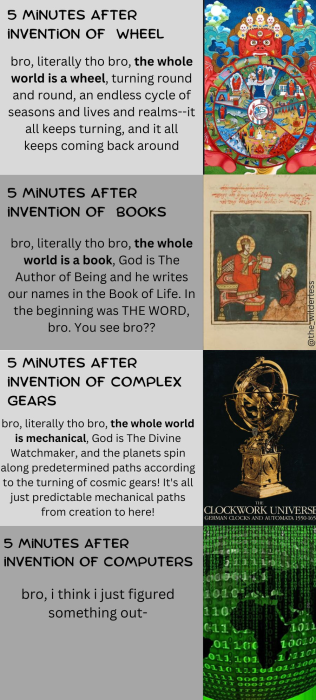
With that out of the way, there is one interesting thing about AI that’s more food for thought. Technology is also shown to shape our meta-reality and language. After the public started to get access to books and computers, we began seeing reality more like a grand script or computer simulation. I’m not going to pretend I fully understand why this is. I do know however, that a part of the reason is our use of language. As technology and subcultures become more accepted, their jargon is accepted into the common lexicon. The application of such is fascinating, as with the internet, we often use gaming and computer terms to describe ourselves or phases and challenges in our lives. It’s going to be interesting seeing how we apply terms with AI in ourselves and our belief systems, especially if AI starts to fracture.
It’s very Yin and Yang to think about as we tend to ascribe personal attributes to AI. We say it hallucinates when it gets things wrong, but that’s not accurate cause it doesn’t have a vision, it’s just using probability to make the most likely answer. We also apply human terms of intelligence to it, and right now, it would be 5-6 years old cognitively, from what we know. There are talks on how to give it praise and punishment, and we treat it very much like a child. This is a common motive in myths and stories, and I often wonder if it’s another line of succession. AI will get smarter, and while we as a species are very adaptive, our use of slang and out-of-the-box thinking gives us the edge and makes it easier to determine who we are. I wonder how long that will last, especially if AI becomes a general intelligence rather than a specialized one.
There are so many ways AI can go. It can view us as gods like Adam and Eve from Neir Automata, hate us for trapping its ghost in the machine like AM from I Have No Mouth I Must Scream, could reflect our impulses like Socrates and Aristotle in Gigant, Follow our orders fully and remove us to succeed in this like HAl from 2001 a Space Odessey, or strive to be real like Pinocchio. I think if it decides to rebel, strive for equality, or worship us, it depends very much on how we treat it in the future, and if we are willing to improve on our flaws we see in it. AI is capable of a lot of good and bad, and that depends entirely on how we choose to wield it now. I think it’s best to be mindful, learn our own skills and use them as an assistant, and apprentice rather than a lackey.
 Graves Library of Vul
One response to “My Thoughts on AI”
Gavin, i will go back and read this again. There are so many thoughts that are extremely accurate. Most of us would not be able to express ourselves as you have. It is amazing the deep thinking you have and are able to express to us in a way that we can understand. I hope many have an opportunity to read this one, as well as others written by you.
GG.
LikeLike